
Fadlullah Wilmot || 3 December 2025
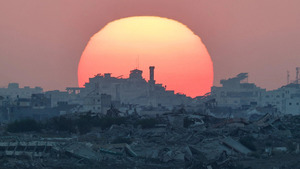 The UN Security Council’s endorsement of Donald Trump’s Gaza “peace plan” has been sold as a breakthrough toward ending the war. In reality, it internationalises Gaza’s fragmentation, siege, and external control. The agreement is built on narrow transactional exchanges – ceasefire for hostages, hostages for prisoners, prisoners for aid – while evading the root causes of violence: prolonged occupation, a 17-year blockade, and the systematic denial of Palestinian self-determination.
The Lop-sided Peace Plan
Far from a new roadmap, it stabilises an unequal status quo with fresh branding and UN cover. It is an eerie reminder of the Dayton Accords in Bosnia where the exhausted Bosnians under international pressure agreed to a settlement that rewarded the genocidal Serbs half the territory of Bosnia.
The politics behind the resolution underscore its fragility. Drafted under heavy US pressure, it was reluctantly accepted by states wary of opposing what was framed as “the only path” to a ceasefire, repeating a familiar pattern in which great‑power geopolitics override the rights of the occupied.The deal promises a ceasefire and a roadmap to reconstruction, but it does so within a framework that redefines Gaza without Palestinian consent, institutionalises Israeli control, and sidelines international law. Instead of restoring Palestinian rights, the resolution locks in the architecture of domination that produced the catastrophe.
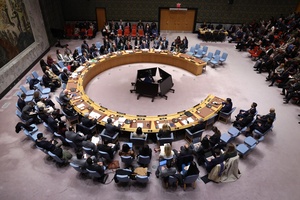
The plan’s core flaw is to separate a temporary cessation of hostilities from any credible political horizon. It creates an International Stabilization Force (ISF) and a fifteen‑member “Board of Peace” chaired by Trump, with sweeping authority over Gaza’s security, reconstruction, and borders, while leaving Gaza’s final status, borders, and relationship to the West Bank undefined. Experience from Namibia to East Timor shows that international forces can monitor ceasefires but cannot generate legitimacy without a negotiated political settlement, clear end‑state, mutual recognition, and enforceable guarantees – none of which exist here.
Authority is substituted for legitimacy and foreign actors are granted executive power who Palestinians have neither chosen nor consented to. The involvement of war criminal Tony Blair, is a warning that Gaza’s future is being shaped by the same Western officials who helped dismantle Iraq under the banner of “liberation.”
Palestinian agency is structurally sidelined. Hamas is ordered to disarm and exit governance; the Palestinian Authority is pushed to a conditional future role pending externally defined “reforms”; and an unelected technocratic administration is made accountable upward to a US‑designed board, not downward to the people it governs. Placing Arab and Muslim troops in the ISF risks turning them into enforcers over Palestinians on Israel’s behalf, just like the current Palestinian Authority echoing earlier colonial governance models of “native authorities” managed by imperial overseers.
The Yellow Line
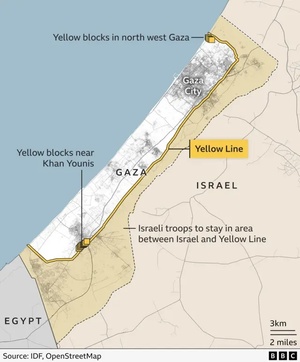 One of the most alarming elements of the plan is the so-called “Yellow Line.” Israeli forces are to “withdraw” not to the 1967 line, nor even to Gaza’s pre‑October 2023 boundaries, but to a new internal line placing large sections of Gaza City, Khan Younis, Rafah, extensive farmland, and all major crossings on the Israeli‑controlled side converting more than half of Gaza’s land into a militarised “security zone.” Hundreds of thousands of displaced Palestinians 80% of whom are descendants of refugees from Israeli ethnic cleansing in 1948 and 1967 will be unable to return to their homes.
Under the Fourth Geneva Convention, an occupying power may neither annex occupied territory nor forcibly transfer its population, and the ICJ’s 2004 advisory opinion held that unilateral barriers built inside occupied territory amount to unlawful de facto annexation. The Yellow Line is, in effect, a miniaturised, internal version of the West Bank separation wall: carving into occupied territory under the pretext of “security,” entrenching demographic engineering, and seeking retroactive legitimacy through “facts on the ground” and international acquiescence.
Accepting Yellow Line as the reference for redeployment, helps normalise a drastic reduction of Gaza’s territory beyond its already mutilated 1948 and 1967 contours becoming a vehicle for long‑term partition.
The contrast between rhetoric and reality is stark. The plan invokes a “credible pathway” to Palestinian statehood, but offers no timelines, parameters, or guarantees. By contrast, it specifies in granular detail: disarmament protocols, an open‑ended foreign security force, tight border and airspace controls, reconstruction confined to “Alternate Safe Communities,” and a “security perimeter” Israel may activate at will. Rather than dismantling structures of siege, it modernises them. These fenced, externally supervised “safe communities” behind the Yellow Line recall colonial schemes of forced relocation, from “strategic hamlets” in Malaya and Vietnam to South Africa’s Bantustans. Reconstruction without sovereignty is containment, not liberation.
The resolution confers international legitimacy on the plan while leaving accountability almost entirely absent. It includes no robust mechanism to address war crimes, the blockade, or violations of ICJ orders to prevent genocidal acts, yet it entrenches a mandate heavily focused on disarming Palestinian groups and “securing borders.” Israel retains wide latitude to re‑enter Gaza, expand the Yellow Line, or impose new restrictions under an elastic “security” rubric, while Palestinians are asked to disarm under foreign tutelage without sovereignty or credible guarantees. The occupying power keeps maximal authority, the occupied gain neither protection nor freedom.
The Untenable UN-endorsed Peace Plan
 A genuine peace framework should prioritise: a full end to occupation and blockade; guaranteed freedom of movement; reconstruction grounded in Palestinian consent; free, coercion‑free elections; accountability for grave crimes on all sides; and recognition of Palestinian sovereignty on the 1967 borders. None of these pillars is meaningfully embedded in the Trump–UN plan.
The UN’s endorsement of this “peace deal” does not move Gaza closer to justice; it endorses a territorial redesign crafted by an occupying power. It internationalises fragmentation, deepens internal partition, and recasts the siege as a globally managed project of containment. By accepting an internal wall, unelected governance, and indefinite foreign security control, the plan transforms a ceasefire into a long‑term architecture of demographic engineering and political guardianship. What emerges is not peace but pacification that historically has been proven unsustainable. “The peace plan is a territorial redesign crafted by an occupying power—omitting accountability, ignoring displacement, and sidestepping self-determination—while resolving nothing.
 Haji Fadlullah Wilmot is a Director at the Islamic Renaissance Front. He formerly served at universities in Indonesia, Malaysia and Australia but after the tsunami in Aceh became involved in the humanitarian and development sector. He has worked in Indonesia, the Philippines, Malaysia, Cambodia, Vietnam, Solomon Islands, Bangladesh, Pakistan, Jordan, Lebanon, Kenya, Sudan, Somalia, Afghanistan and Iraq. As a volunteer with the Australian Muslim Advocacy Network he is now monitoring anti Muslim hate speech in the electronic as well as social media that is exploding in response to right wing posts about what is happening in Gaza and also works with organisations supporting Muslim converts.